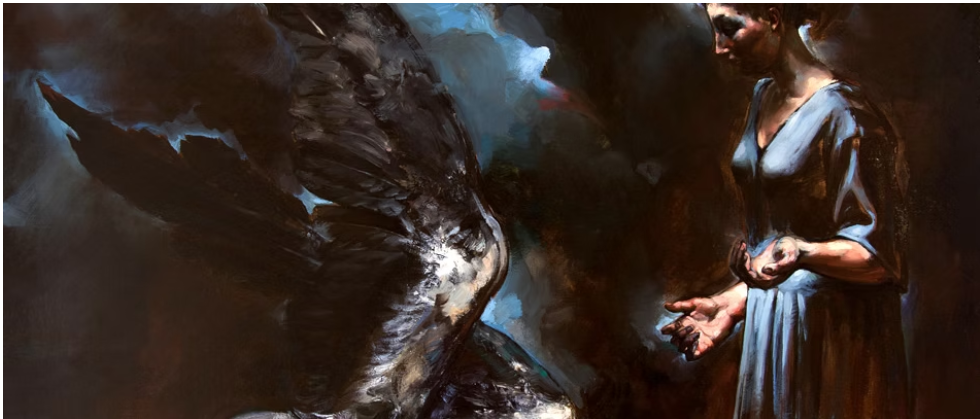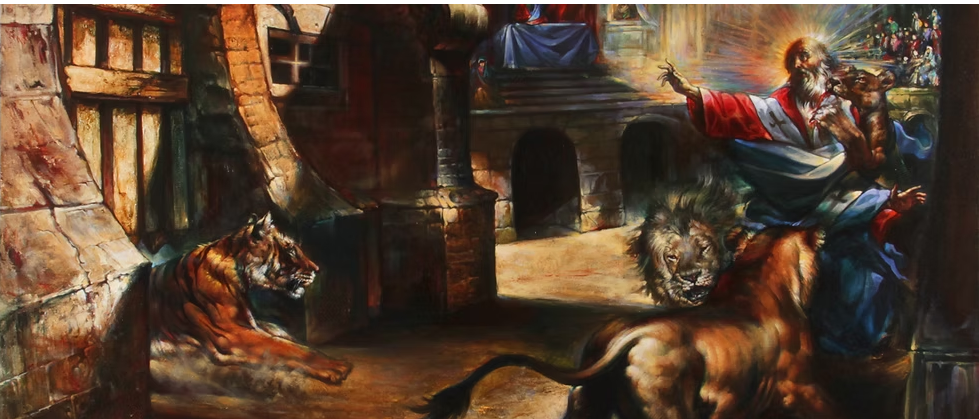
Niko Chocheli is a Georgian-born artist with an atelier north of Philadelphia. I have twice brought artistic granddaughters up for a week of in-person guidance, then followed through the year with his assignments and phone critique. His work is amazing to me, and his style unmistakable. Here’s a letter he wrote to a promising student years ago, with wisdom for artists that is timeless.
Niko Chocheli + Chocheli School of Arts + Buckingham, PA
Dear Eve,
It was an honor for me to be asked to write some words of advice to you as your art teacher. As an artist who has made it his life’s pursuit to honor truth and beauty, and who has sought to impress these virtues through the mediums of fine art, literature, history, religion and philosophy, these ideals have shaped who I am and the art that I create. These ideals are not limited to the field of art alone; they are universal. They can be applied to the pursuit of any career, or to life’s highest pursuit: becoming an honest person of virtue. Still, I have written from the perspective of an artist. Much has been written about Art through the centuries, and there are some truths which are timeless, which one would do well to preserve and cultivate throughout life. There are many things could have written here, but I think these few suggestions are the most important concepts to cultivate first.
Having observed your growth as an artist, I anticipate a very fine future awaiting you. You possess may qualities of a true artist. In addition to having artistic talent, you are a well-disciplined, hard-working, and attentive student. What adds grace to these academic traits is your positive and respectful attitude, which will serve you well on whatever path your goals lead you. I would like to offer you seven principles to take with you as you grow and learn to walk on that path with courage and determination.
1. As a Christian, your number one priority must be God, always! He is the Creator of us all, the originator of Beauty, the Giver of all good things, and the Greatest Artist whose beautiful Creation can serve to inspire you all your life. We must humbly imitate Him, be like Him, and glorify Him through our calling. If that calling is art, then our art can become one way that we can aspire to be like Him. God is the ultimate Creator, whom we imitate. Unlike Him, we cannot create new life forms. Everything that we create was inspired by His Creation. Therefore our humble imitation of His Masterpiece, the Natural World, is a fine use of our talent in His service. He made us in His image, and so we have “inherited” His gift or talent of creating. The more beautiful that your art is, the greater honor may be given to God. Not only by being a reflection of God’s creation, but by also using Beauty to give Joy to the viewers of our art, and thus blessing others’ lives.
2. Priority number two for a good artist is to be a fine human being, and here as well we cannot do better than to follow God’s moral teachings. Art is not more important than God or your neighbor. Your art will be richer if you are a compassionate, charitable, and loving person that is humble and modest. It is vital to your art, and to your soul, to keep this perspective: that God can use others to teach you (always remain teachable), and always remember that your artistic talents were gifts given to you, not just for your own personal enjoyment or ego but to bless God, others, and yourself.
3. Read! Read! READ! Read fine books, classical literature, great poetry, the Bible, Church history, and World history. Learn about the virtuous and great men and women of the past. Education for the fine artist is a significant priority. A good artist is not only a skilled draftsman or painter, but also a virtuous and educated human being as well. If an artist has excellent technical skills but is empty inside and shallow, his art, which is a reflection and mirror of the soul, will also be empty and meaningless, and will not withstand the test of time. Learn the history of your country. A good artist is strengthened by having a love of one’s homeland and patriotism.
4. Go to Museums. This country has many of the finest collections. Spend time in reverence before the canvases of the Great Masters. This will be a great school for you, silent yet eloquent.
5. Another priority for a fine artist is to develop good taste, that is, the ability or sensitivity to recognize and appreciate true beauty. Only the work of the fine Great Masters can truly teach and influence your good taste, not the fleeting fashions and trends of today’s modern art. Once you’ve learned to recognize true beauty, you will become sensitive to it, and be able to find and distill it from observing nature around you. This will show through in your art and you will share it with others. By spending time in great museums, and in nature, you will learn about and be able to detect pure beauty.
6. In your creative endeavors, always strive to be honest and sincere in your work. This will ensure that you will be a true artist, with a warm heart and passionate dedication to your art. An ability to be amazed and excited at the sight of beauty will give you the fire to create. Coldness puts out life. Warmth breathes life So be passionate in art by striving for constant growth and perfection, Do not be too easily satisfied by your efforts. Always strive to move forward.
7. As far as technical skills, draw, draw, DRAW! Draw every day. The Old Masters taught us this motto: No day without a line! This would be my advice as well. Always draw, and, as the masters taught us as well, if you don’t have a pencil, draw with your eyes. You have to have two teachers: Nature and the Great Old Masters. Nature will be a big sourcebook of images, and the Great Masters will teach you how to read it. And God has created all of these things: one cannot help but draw closer to Him when studying His workmanship in every living thing surrounding us.
As a student of art you have worked hard, you have learned quickly, and you have grown very fast. These are all very encouraging signs that you have the potential to “go far” with your art education or whatever field you study. As you pursue your education in college there will be many new challenges and opportunities you will face. There will be the excitement of working alongside others passionate about their future, focusing on your goals, and learning new things. There will also be competition, hours of study, distractions, obstacles, failures, mistakes, dry spells, disappointments, opposition, and some jealousy, but you must persevere and be strong. What you are pursuing is a pearl of great price, so expect that it won’t be easy io obtain.
Think of the great sculptor Auguste Rodin, who was not admitted to the Academy year after year, but he persevered and conquered it in the end.
Think of Abraham Lincoln. From 1832 forward he lost his job, was defeated and failed several times in his efforts as Speaker of the House, in his bids for nomination to Congress, the Senate, and the Vice Presidency. He had been rejected and defeated over and over, yet in 1860 he was elected President of your beautiful country. Throughout his political career he had fallen several times, but he had never given up, and he became one of the greatest fathers of his nation.
There are so many similar stories of great artists and statesmen who dealt with rejection, disappointment, being misunderstood, even made fun of, who persevered in pursuit of their vision and whose legacy became glorious in the end.
So be encouraged: God has given you talent, and your duty is to not hide it under a bushel, but to make it shine brightly for the glory and honor of God, your country, your family, and to pursue joy and truth in the path of life that you forge. I wish you all the best, and look forward to continue to coach and assist you at the Chocheli School.
Sincerely,
Niko Chocheli