This post is actually some further thoughts on “My Experience of the Jesus Prayer.” I have also added it to the end of the original post, so you can read it all in one place.
The words of the Jesus Prayer are “Lord Jesus Christ, have mercy on me.” But many variations are possible: “Lord Jesus Christ, Son of God, have mercy on me,” or “Son of the Living God,” or “…have mercy on me, a sinner.” As you try out using this prayer, repeating it maybe just 20 or 30 times at first (you can count ‘em off on your fingers), you’ll find that you gravitate toward a longer or shorter version.
I started out using the shortest version, “Lord Jesus Christ, have mercy on me,” because I wanted to get it over with. I was an important person and needed to get back to the important business of writing and speaking and benevolently granting interviews. (The year I started praying the Jesus Prayer, 1995, I published 75 magazine articles and wrote Facing East.)
God was so good to me. Even though I was a certifiable, solid-gold, self-centered fool, he accepted the ultra-thin prayer I was willing to part with, and deepened it. Over the years it changed, becoming ever more meaningful. I sensed the presence of Christ more and more, not only while I was saying the prayer, but here and there during the day.
And that presence was compelling. It felt like life; he is “the Way, and the Truth, and the Life” (John 14:6). I wanted to pray in a way that would help me connect with that Life more consistently.

I began to see that I needed to address Jesus when I said the prayer, and direct it toward him. That seems so obvious now! But I had been fixated on saying the words over and over, like it was a “prayer discipline” that must be executed in a disciplined way. I didn’t see that I needed to face him and speak to him from the heart. Yet he was good to me, and kept leading me. And so things went for decades, gradually deepening and expanding.
I also came to see how fatuous I looked to the saints and angels, as I preened the feathers of my brilliant career. I was able to see that, embarrassing as it was, because of the improving ability to pray God was giving me.
And then—and this would not be general advice, it’s just something that happened to me, and I should put it in for completeness. What happened was that, somewhere in the early 2000’s, I suddenly felt an urgent need to stop writing. To reduce it to just a trickle, maybe put out an occasional book. But I had an overwhelming determination to stop.
I didn’t understand why this was happening, though I embraced it firmly. I remember being at a Chicago event in 2010, telling Jim Kushner (then editor of Touchstone), “I don’t want to write. I want to not write.”
It took a while to fulfill all my obligations, and a longer while for editors to stop asking me. Meanwhile, this unsought impulse to shut up was clearly making room for more focus and flourishing in prayer.
Why that’s connected is because writers are writing all the time. Not just when we’re at the keyboard. Wherever we go, the words keep surfacing and rolling around, and the art of mentally describing, rephrasing, improving, and polishing is very satisfying. It’s hard to resist. The wife of midcentury author James Thurber would come up to him at a party and say, “Thurber, stop writing.”
Words are so delightful! I am grateful that God enabled me to do what I enjoy most in life. And I’m grateful that he pulled the plug. It made my prayer life so much better.
More recently, something else happened. I began to get the feeling, when I was saying the Jesus Prayer, that somewhere just out of sight there were millions of others, a countless multitude, lifting their voices in the praise and glory of the Lord. I kept recalling that line from the Christmas story, when the angel is addressing the shepherds, “and suddenly there was with the angel a multitude of the heavenly host” (Luke 2:13). It was like I could glimpse that multitude all around, in timeless, limitless, ceaseless in adoration.
When that started happening, I felt like I should drop the concluding phrase, “have mercy on me.” Under the circumstances, it felt like I shouldn’t be talking about myself. I worried about this, because it is so entirely appropriate for me to ask for mercy! But the feeling I was getting was, “Shut up about yourself, already.” The time had come to render pure praise. So the second part of the Prayer fell away, and I kept repeating his name: “Lord Jesus Christ.”
Those three words are so meaningful. I call him Lord because he is my Lord, and I follow him and try to discern his will and do whatever he brings my way.
He is Jesus, the name chosen before his birth. The angel spoke separately to Mary and Joseph, and told them that the baby’s name would be Jesus, “because he will save his people from their sins” (Matthew 1:21). The name Jesus means, in Hebrew, “God will save.” When Gabriel says “he will save his people” the Greek verb sozo means “save” as in rescue, like “saved you from drowning.” That kind of “saved,” not “intervened and paid your debt.”
I had been a Christian decades before it occurred to me that this means Jesus can rescue us from our sins, not merely from the penalty for our sins. He can free us from the sins themselves. We will still fail over and over to take his outstretched hand and be lifted from the mire. We like mire. But he can do it, and make us not merely debt-free in his Father’s sight, but transformed and filled with his light.
So I began praying just “Lord Jesus Christ” over and over. Instead of repeating a prayer I was calling his name. There is such immense love in his name, and millions of others who love and adore him, angels and humans together. Words fail me.
While we’re talking about it, I wanted to give some general suggestions for arranging your own daily prayer time. And I recommend assigning yourself more than you’re capable of doing. In reaching for that goal, you will at the point of giving the maximum you can; and in falling short of that goal, you will be beneficially humbled.
Plan to have some kind of prayer time every day. Even if you can only spare five minutes, pick a time when you can get away for five minutes and focus on the Lord. Even if you do it badly, or sometimes don’t even show up, that dedicated space is where your connection with the Lord will be built. Eventually the connection with him will fill all your waking life (and sleeping life too, I believe); it will overflow your set-aside prayer time and illuminate everything.
There are a number of different things you might want to do in that space—Bible reading, the Jesus Prayer, praying for other people, asking forgiveness of your sins, reading about the saints honored that day, and other things too. Most people, I think, expect that they are meant to do all these things in one dedicated daily prayer-time.
Let me suggest, though, breaking these bits apart and doing them at different times of the day. Plan instead for a number of smaller and shorter prayer-times. That way, you’re likely to hit at least some of the targets.

I can tell you how I arrange my daily prayers. First, and most strangely, I have my main prayer-time in the middle of the night. Let me hasten to say, almost nobody does that. You will be in excellent company if you don’t do that.
Where I got the idea was, when I was pregnant with my first baby, I read it in a Christian magazine. The idea was that the house would be quiet, the phone wasn’t going to ring, and there would be no chores or interruptions. I thought, “I’ll be getting up anyway to nurse the baby,” so I started doing it. (That baby is almost 49.)
I don’t set an alarm or anything; at some point I just swim up to consciousness and get up. I take my prayer rope and pray for an hour or so, and then return to sleep. That’s probably not practical for many people! I just wanted to mention it. I have used that time for many different aspects of praying over the years, but at present I say 200 Jesus Prayers.
When I first get to my desk in the morning I read the Lives of the Saints (this is a wonderful website for that), and read Scripture and maybe some other devotional book. Then I pray about the prayer-requests that have come in to the church office. Then pray for the members of my church; I divided the church directory into 6 days and printed it out, so lots of people at my church are praying these names together. (I recently reorganized the list to put people together by zip code. Our congregation is far-flung, and this way parishioners can know who their neighbors are.)
In the early afternoon I say 100 Jesus Prayers with my family members in mind. Lastly I have my own semi-permanent prayer list, about 75 names, and the time of day I do it has moved around. At present I just get to it some time in the dawn-to-dawn 24 hours.
I don’t have anything particular for the end of the day, but I ought to come up with something as a marker. I do shift my plan around with some regularity. And the Jesus Prayer is always good for going to sleep.
When the time for your prayers comes, if you don’t feel like doing it, do it anyway. If you’re going to overcome your self-will, you’ve got to do things you don’t want to, right? If you don’t feel like praying but do it anyway, that is the “sacrifice of praise” (Hebrews 13:15). Every time you do it even when you don’t want to, it chisels off some of your rough edges. Everything gradually gets easier and more inviting.
Having these prayer-spots scattered through the day has the benefit of reminding you to pray. “Is it time for the noon prayer? Not yet.” And in that moment you briefly looked toward the Lord, and doing that, just nodding toward him, is a kind of prayer all by itself. When you have a number of small prayer-times during the day, they gradually draw together and link up, and then you’re thinking about the Lord and staying beside him all the time. “Pray without ceasing” said St. Paul, over and over again (1 Thessalonians 5:17, Romans 12:12, Ephesians 6:18, Colossians 4:2).
This can’t mean talking to God all the time; that would wear you out. (You wouldn’t want to hang around with a friend who talked without ceasing, either.) What “Pray without ceasing” means is being beside the Lord, staying in his presence, so that everything that happens to you takes place in his light.
It’s the difference between taking a walk in the woods by yourself, or with your best friend. You might not be talking to your friend all the time, but you’re always aware of his presence, and having him there changes the whole experience. In time, you’ll be able to sense your friend Jesus like that, always beside you. He’s already there now; you just haven’t learned how to sense it yet.
But you can’t force this to happen. It is one of those things that comes to you when you’re not looking. The one thing you can do is to try to be faithful to your prayer rule.
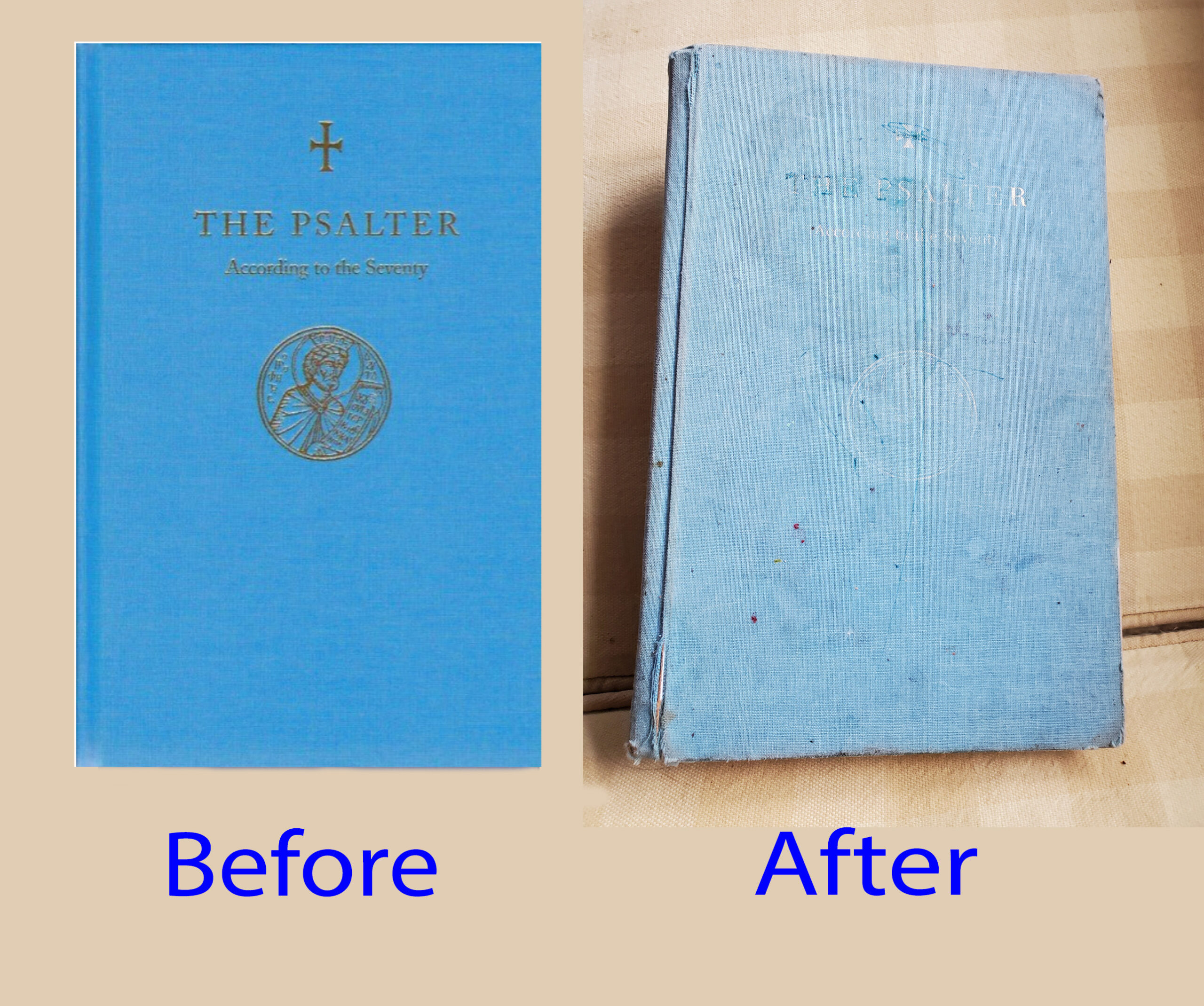
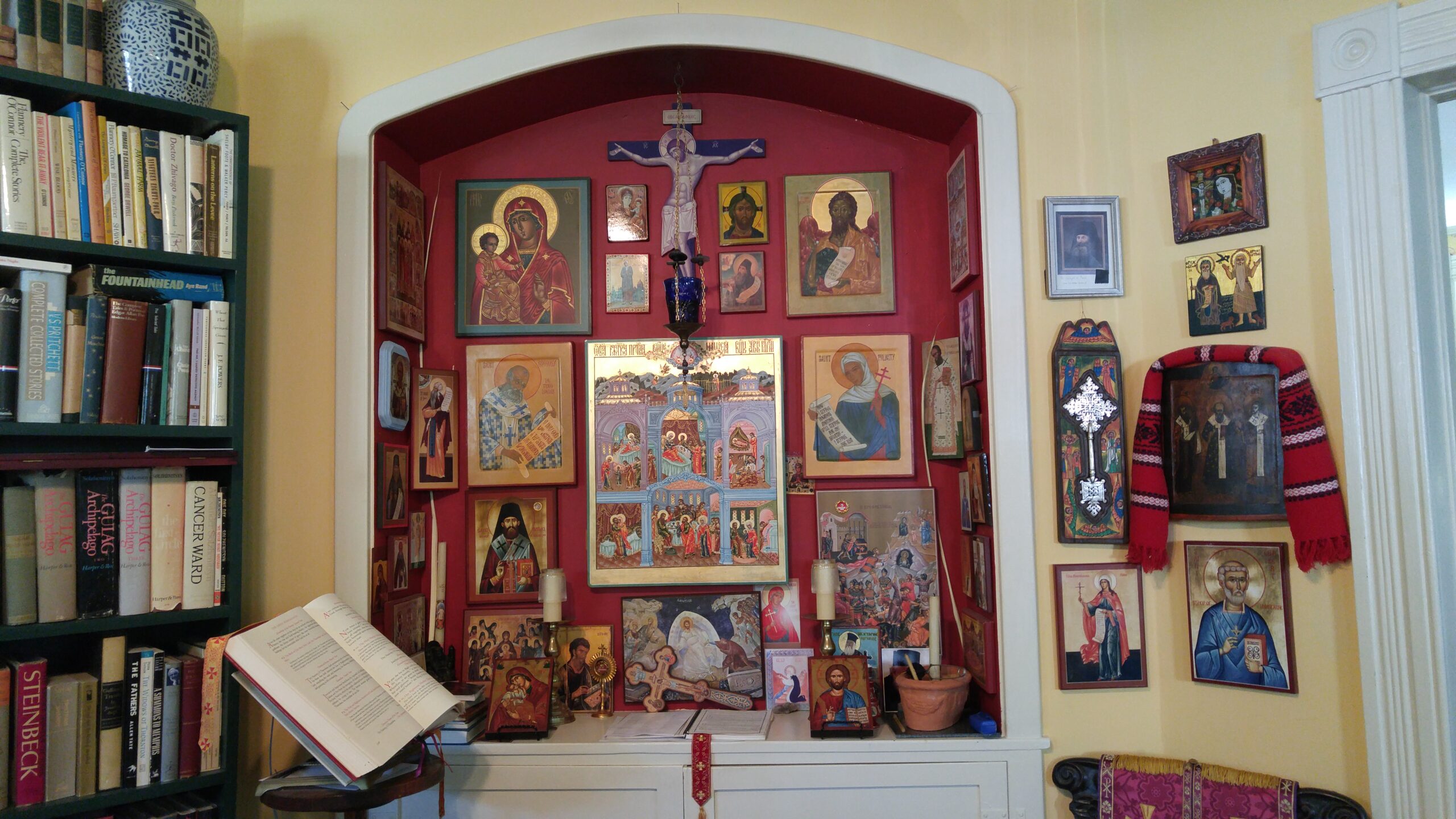
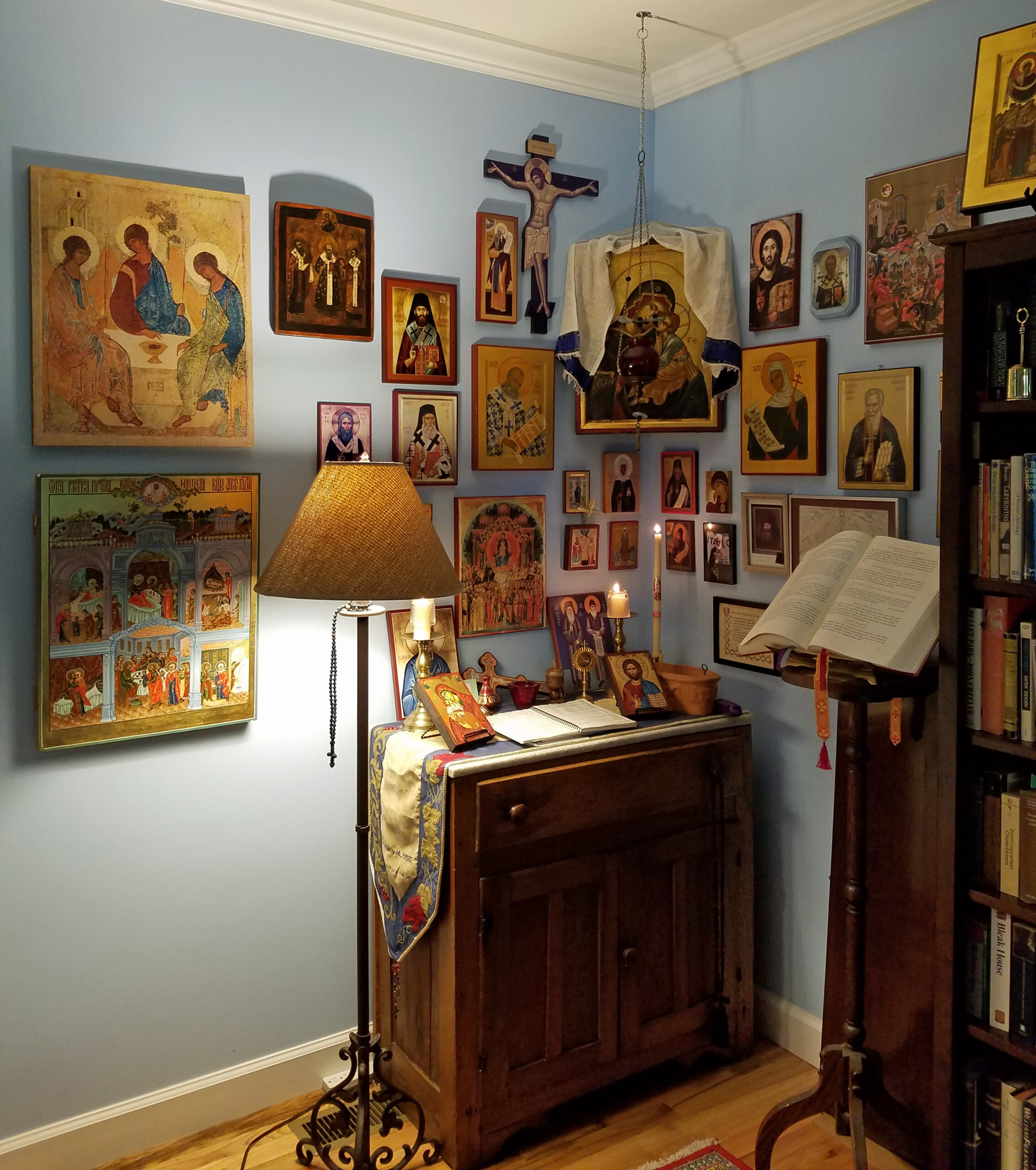
You might also want to set up a particular place in your home where you go to pray. Orthodox Christians have an “icon corner” (not necessarily in a corner) where they have an icon of Christ and, to the left, one of his mother; then they gradually add icons (even photos) of other saints whom they love. A shelf or bookcase below the icon corner might hold a bible, a book of saints’ lives, prayer books, a psalter, incense and charcoal and a brass censer, a cross, a prayer rope, anointing oil, holy water, beeswax tapers, and a small flowerpot full of sand to hold candles. (With all this going on, an icon corner gets to looking spattered and dusty.)
I like to claim that my icon corner “won the internet.” This was in the house where we lived for 20 years, when my husband was pastor of Holy Cross Orthodox Church in Linthicum, MD.
Now we live in a brick rancher in northeast Tennessee and space is more limited, so our icon corner is smaller.
Soon after my conversion experience I read a little book called The Practice of the Presence of God. It collected the sayings of a Carmelite friar named Brother Lawrence, who worked in the monastery kitchen. He said, “In order to form a habit of conversing with God…we must first apply to him with some diligence; but after a little care we find his love inwardly urges us to do so, without any difficulty.” Well, that sounded fine to me.
Then I read that it took him ten years to get there. Ten years?!? Who has ten years?!?
Well, it turned out I did. Many times ten years, over and over. Those years are going to pass anyway, so why not start tonight?