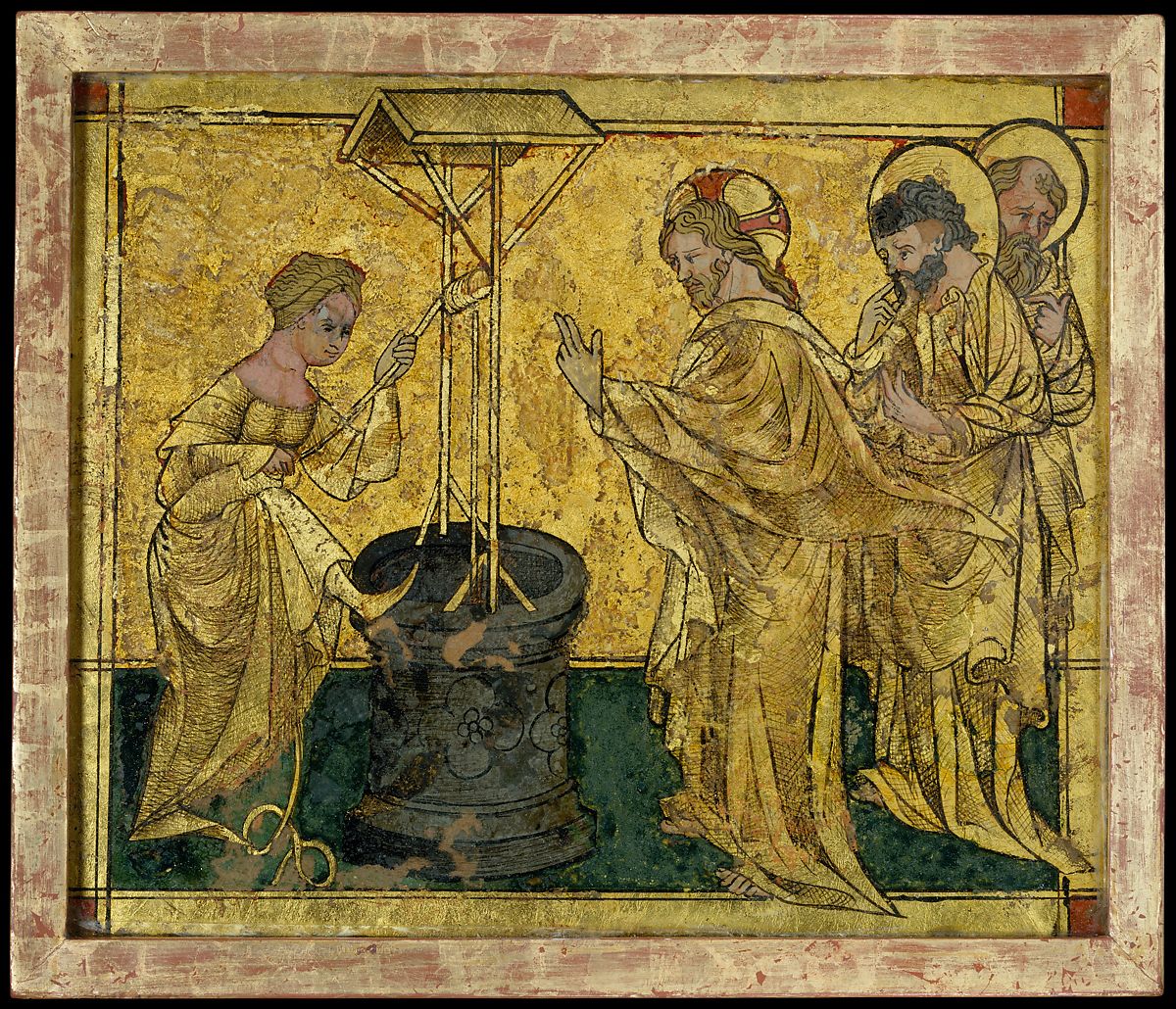
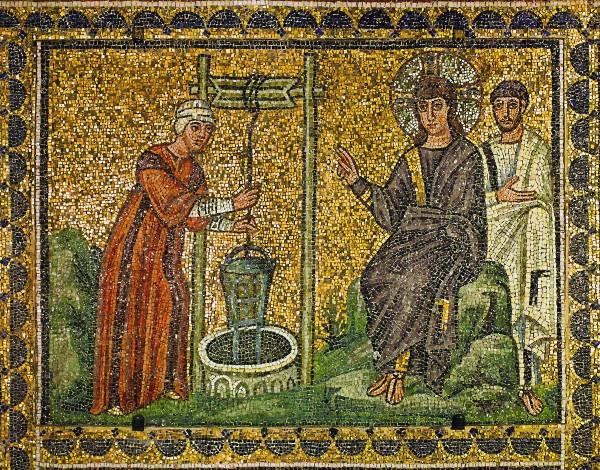
The “woman at the well,” that vivid figure in the 4th chapter of St. John’s Gospel (John 4:16-26), who converses with Christ beside the well, is known to the Church as St. Photini. She’s a remarkable figure and clearly an intelligent woman, though her irregular romantic life probably made her a figure of contempt locally.
It’s hot at noonday, and most people wouldn’t go to draw water at that time; water is heavy in a clay jar. Maybe it was Photini’s habit to go at that time so she wouldn’t be scolded or snubbed.
When Jesus asks her for a drink, she’s surprised, and says so. Christ goes on to speak with her, and she listens and asks good questions. But when he tells her, “Go, call your husband, and come here,” she says she has no husband. Jesus says “You are right in saying, ‘I have no husband,’ for you have had five husbands, and he whom you now have is not your husband; this you said truly.”
Photini must have been taken aback, but in her profession it’s good to have a talent for tactfully steering a conversation. So, instead of responding to his comment directly, she pays him a compliment (“Sir, I perceive that you are a prophet”), then deftly changes the subject. She knows that, if you want men to forget what they were talking about and go off in a different direction, ask their opinion on political or religious controversies. So she says to Jesus, “Our fathers worshiped on this mountain; and you say that in Jerusalem is the place where men ought to worship.” She brings up the bitter division between Samaritans and Jews: are you supposed to worship on Mt. Gerizim or Mt. Zion?
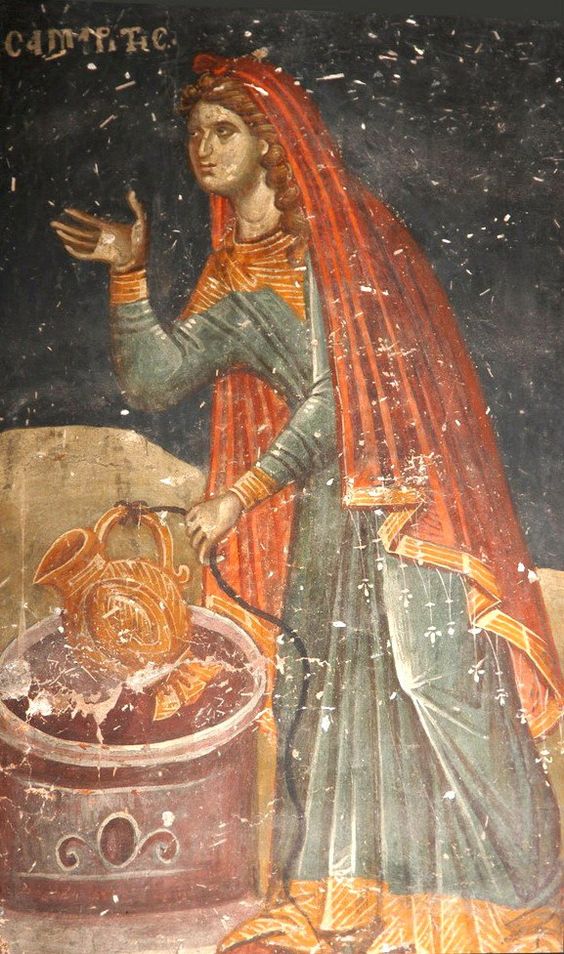
But when Jesus responds, he talks about right worship in terms so profound that it must have baffled her: “Woman, believe me, the hour is coming when neither on this mountain nor in Jerusalem will you worship the Father. You worship what you do not know; we worship what we know, for salvation is from the Jews. But the hour is coming, and now is, when the true worshipers will worship the Father in spirit and truth, for such the Father seeks to worship him. God is spirit, and those who worship him must worship in spirit and truth.”
So Photini pulls out the diplomatic standby: Well, no one knows the answer, of course. “But when [the Messiah] comes, he will show us all things.”
“I who speak to you am he,” Jesus says.
I picture her opening her mouth to reply, then closing it, then staring at him steadily for some seconds, as if seeing him for the first time. Then she puts down her water jar—it might slow her down—and hikes back to the city as fast as she can go. She stops every person she meets and says, “Come, see a man who told me all that I ever did.” There’s no sense in hiding her shameful history now. “Can this be the Christ?” she asks them.
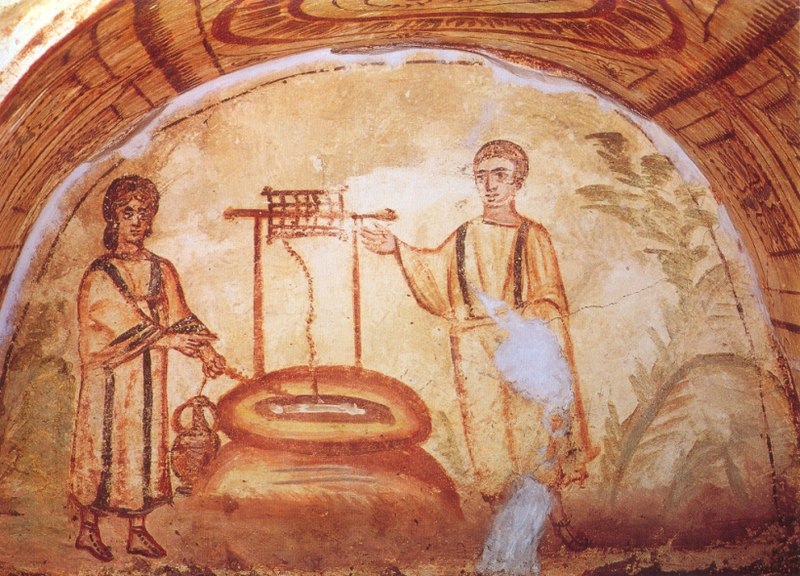
John 4:39-42 says: “Many Samaritans from that city believed in him because of the woman’s testimony, ‘He told me all that I ever did.’ So when the Samaritans came to him, they asked him to stay with them; and he stayed there two days. And many more believed because of his word. They said to the woman, ‘It is no longer because of your words that we believe, for we have heard for ourselves, and we know that this is indeed the Savior of the world.’”
Photini, the woman at the well, was one of the first people to preach the good news of Jesus Christ. She knew that he was the Christ even before his death and resurrection. In the Christian East, St Photini is called “Equal to the Apostles.”
We see no more of her in the Gospel of John, but here’s how Eastern Christians have preserved the rest of her story.
She was baptized as a follower of Jesus, and that’s when she received the name Photini, which means “Enlightened.” She continued to preach the gospel throughout the region, and eventually moved with her family—five sisters and two sons—to Carthage (in present-day Tunisia). They became so publicly notable as preachers of Christ that the Emperor Nero had them all arrested and brought to Rome.
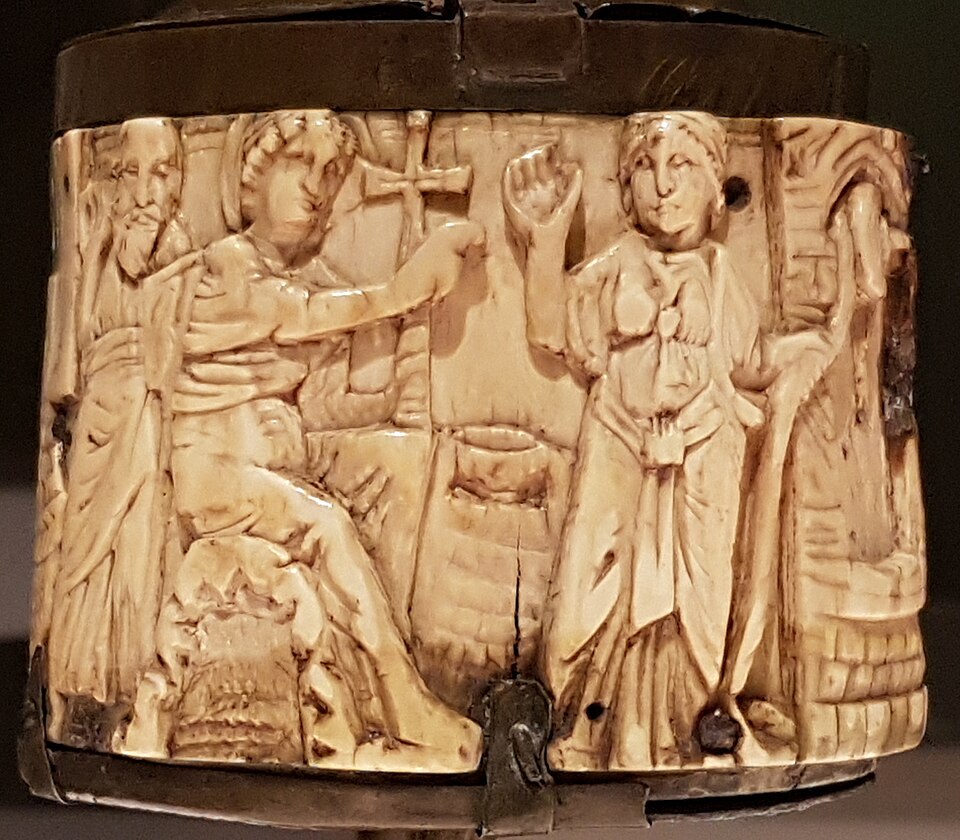
There Photini was compelled to witness the torture and death of every member of her beloved family. Her sons were blinded and their legs were cut off, and then they were thrown out to be eaten, alive, by dogs. Her sisters’ breasts were cut off, and then they were flayed, that is, skinned alive.
After this butchery, Nero gave Photini a final chance to deny Christ. I picture her as middle-aged by then, thick of waist, her hair streaked with gray and face weathered by wind and sun. On the day she met Christ she may have been a young beauty, but that was many years ago. And yet her mind was still as nimble, and her manner as bold, as it was on that day long ago, in the noonday stillness by the well.
Photini had great courage. It is said that she spat at the emperor and made fun of him. She called out, “You profligate and stupid man! Do you think me so deluded that I would renounce my Lord Christ, and sacrifice to idols that are as blind as you are?”
Photini was flayed alive, like her sisters, then thrown down a well. She died in AD 66.
St. Photini, Equal to the Apostles, is remembered every year on March 20 and on the Fifth Sunday of Pascha (Easter). It’s quite an honor to have two observances, including a Sunday of your own. Here are three of the short hymns we sing on her feast:
Having come to the well in faith,
The Samaritan woman beheld you,
O Christ, the Water of Wisdom;
Whereof having drunk abundantly,
She, the renowned one,
Inherited the Kingdom on High forever.
Photini the glorious, the crown and glory of martyrs,
Has this day ascended to the shining mansions of heaven,
And she calls all together to sing her hymns,
And receive in return God’s grace.
Let us all with faith and longing extol her,
Singing gladly with triumph and joy.
All illumined by the Holy Spirit,
You did drink with great and ardent longing
Of the waters Christ Savior gave unto thee;
And with the streams of salvation you were refreshed,
And abundantly gave then to all who thirst.
O Great Martyr and true peer of the Apostles, Photini,
Entreat Christ God to grant great mercy unto us.
Now, you can doubt every word of Photini’s story, but if you acknowledge at least that she was a real human being, and that she probably didn’t drop dead the day after she met Jesus, then she must have done something with the rest of her life. If St. Peter and St. Paul were moved to preach courageously, even unto death, why not her?
We in the West, at the end of two centuries of “Enlightenment” (Photini would laugh at that variation on her name), are reflexively skeptical, maybe more than we need to be. A determined belief that this woman was named anything but Photini, and did anything but preach about Jesus, would be just as much a leap of faith, and just as unverifiable. One of the treasures of the ancient church, East and West, is that it has preserved “the rest of the story” of figures we know and love from the New Testament. They are “faces in the cloud,” among the “great cloud of witnesses” of Hebrews 12:1. They are alive today in the Kingdom of God, standing in fellowship with each other, worshiping before his throne, and always ready to pray for us.