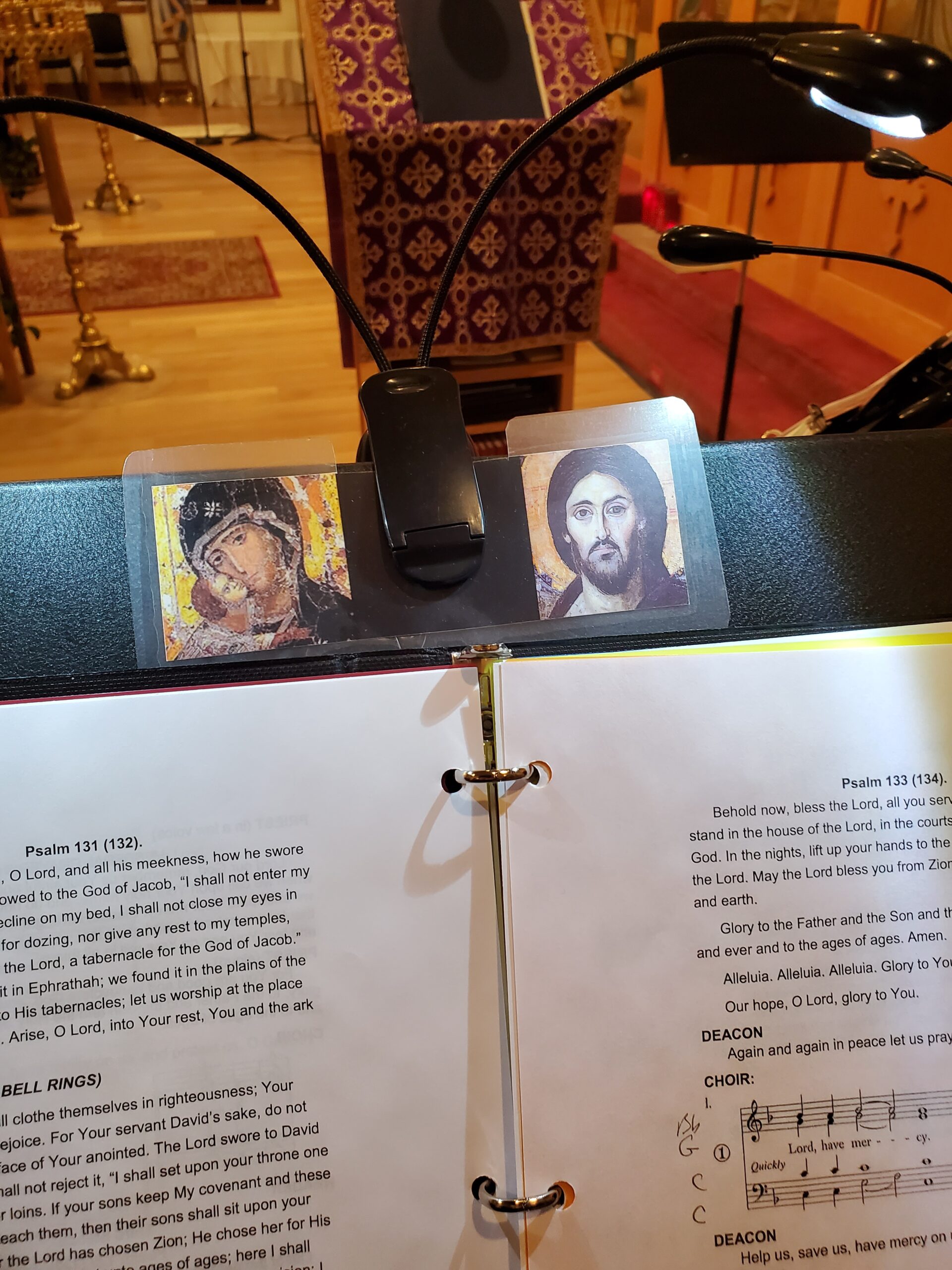
Depending on where the choir stands in your church, they may not have a good view of the iconostasis. I printed out these two Greatest Hits among Orthodox icons (Virgin of Vladimir and Christ of Sinai) for the music stand I share with other sopranos. (The black square in the middle was for the light clip.)
Think members of your choir would appreciate one of these? Feel free to print out the one I made, below, or design your own! I don’t think it necessarily has to be laminated, but the colors will run if splashed with water (all too likely in the upcoming week).
This icon of the Christ of Sinai looks all the more startling, reduced in size. To understand what the iconographer was trying to communicate, cover one side of the face, and then the other.

Two videos this week! Here is the first half of a good conversation I had with Zac Porcu (Journey to Reality) about femaleness: what is distinctive about womanhood? (Zac uses the term “Feminine,” and it takes a certain amount of masculine heroism to think that word can be redeemed.) We went some interesting places. I reflected on the fact that little girls want to be pretty and admired, rather than be one member of a team and do dangerous things, and what the survival purpose that self-protectiveness might serve.
(I can’t seem to ever talk about that without some people thinking I’m saying girls should be satisfied to be pretty and admired. No, I’m talking about something girls instinctively do, that anyone could observe. Exceptions only prove the rule.)
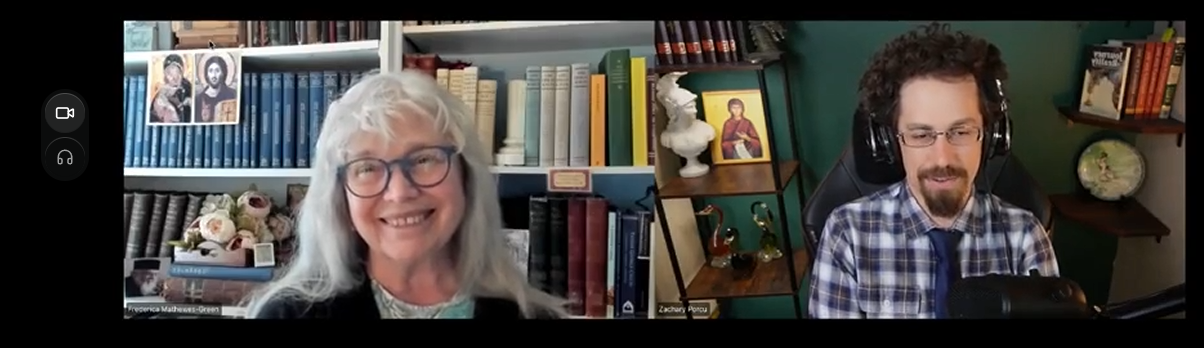
Zac summarizes our talk:
«In the first part of our discussion, an analysis of why little girls loved Elsa in Frozen even though Anna is the real hero of the story. She basis her analysis on the female awareness of her physical vulnerability and the way to secure male attention and devotion as a survival strategy for her children, both in how that goes right and how it goes wrong. We also discuss the young girl’s awareness of death and the risks of childbirth and how boys and girls have to grow up with an awareness of death in different ways.»
Second half of our conversation next week. Audio version here:
And here’s a talk I had fun with, from this past October. It was the first “Art of the Tamada” weekend, held in Greenville SC at the Keipi Restaurant, where guests can experience a Georgian “supra” feast. A significant part of a supra is a series of poetic toasts given by the tamada, the toastmaster, who also encourages guests to offer their own thematic toasts. (Two more “Art of the Tamada” weekends coming up!)
But first, introductions. John Heers is the Director of the First Things Foundation (no relation to the magazine): «Field Workers spend 2 years supporting local projects around the world, giving up their western comforts to transform themselves, listen to the needs of others, and bring beauty into the world.» Keipi Restaurant belongs to the First Things Foundation, and all available profits from the restaurant go to the FTF.
The focus of the weekend was on hospitality, but instead of talking about being a host, I reflected on the experience of being a guest. When is that uncomfortable? When is it most inviting?
Where am I, you may ask? The conference was held at the Keipi restaurant, and the large grassy lawn in front of the small shopping center. Talks were, creatively, held in the furniture store next to the restaurant. If you spill your coffee, you bought it.
A friend wrote me about having had some houseguests recently, and that she had been tense due to the necessity of “hostess attentiveness.” I replied:
Some years ago I realized that, when I was a guest, hostess attentiveness just made me nervous. There we were, both of us being nervous, rather than enjoying each other.
So I changed my approach. Now, when houseguests come in the door, I tell them that I practice a hosting philosophy of “Benign Neglect.” (I remembered that from high school English History—King George II looking the other way while the Colonists broke trade laws.)

So they should, most sincerely, make themselves at home. Feel free to open the kitchen cabinets, look around in the fridge, and eat whatever they want. There’s the Keurig, with coffee pods and a big selection of tea. There’s the pantry. There’s the breakfast cereals. We will have dinner together, but other than that you should help yourselves.
The house is full of books; take them down and read them. The TV is in the guest room; watch whatever you like. We’ll have daily expeditions, but when we’re home, feel free to do whatever you like.
Then, if there are kids, I say “Do you want me to show you where the toys are?”