This Sunday, in addition to being the feast of my patron, St. Felicity of Carthage, is also the beginning of the 70-day journey to Pascha. All the liturgical texts for those 70 days are contained in a big book called the Triodion, so this period of time is sometimes called “the Triodion.”

If you go to Vespers this Saturday, you’ll see that the Triodion book has been set on the floor, leaning against the iconostasis, beneath the icon of Christ. In the middle of the service there will be a pause while the head chanter goes over and picks it up. That is the moment when the Triodion begins.
And everyone’s stomach drops because, here it comes: Great Lent, seven weeks of fasting from meat, dairy, fish, olive oil, and alcohol. When my husband was pastor of Holy Cross Church he would say, “Lent is coming like a freight train.” This made nobody feel better.
But here we are, not quite in the Triodion. Before Lent proper begins we have three Sundays of preparation, in which we hear Gospel readings on the Publican and Pharisee, the Prodigal Son, and the Last Judgement. And every year I get annoyed at the online discourse that assumes haughty superiority to the Pharisee, and judges and condemns him. Adventures in missing the point! (The elder brother of the Prodigal gets the same treatment.)
Listen, if we’re supposed to love everybody, we have to love the Pharisee too. We must see that we are sinners like he is, and not presume superiority. We must pray for anyone like him to come to a deeper faith and be saved. We are all together in this boat, all sinners who are dependent on God’s mercy.
But today I want to pick on a bit of historical inaccuracy. Somehow it’s widely assumed that the socially-rejected tax collector was poor, and the self-satisfied and socially-welcome Pharisee was rich. That’s how they’re depicted in popular art:
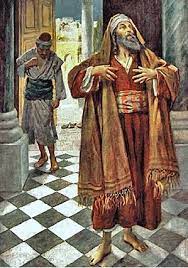
It’s all right to depict the Pharisee as rich; some were and some were not. The Pharisees were a devout Jewish sect in Jerusalem, deeply committed to fulfilling the Law, because their Scriptures appeared to present that as the best way to serve God.
(The Pharisees were not the most elite class in Jerusalem; that distinction belonged to the Sadducees. Pharisees believed in the resurrection, but Sadducees did not. That’s why the Sadducees taunted Jesus with a question about a widow who was handed down from one brother to the next, Matthew 22:25-30. “OK, in your so-called ‘resurrection,’ whose wife would she be? Answer that, smart guy!”)
The Pharisees opposed any attempt to rebel against Rome. They had an accurate understanding of Rome’s power. Rebellion was hopeless and would always be crushed, with as much bloodshed as Rome thought necessary. That’s why the Pharisees insisted that Jesus must be killed, because they thought he was going to lead one of those doomed uprisings.
From the perspective of history, it was a terrible decision (though no doubt in God’s plan). But we have to admit that we might have agreed with it, if we knew only what they knew. There’s another thought useful for our humility.
Whether rich or poor, all Jews lived under the oppression of Rome. Americans have tremendous affection for oppressed people; our national story is founded in rebellion, and we get nostalgic about it. But the tax collector is not the oppressed one here. The Pharisee is.
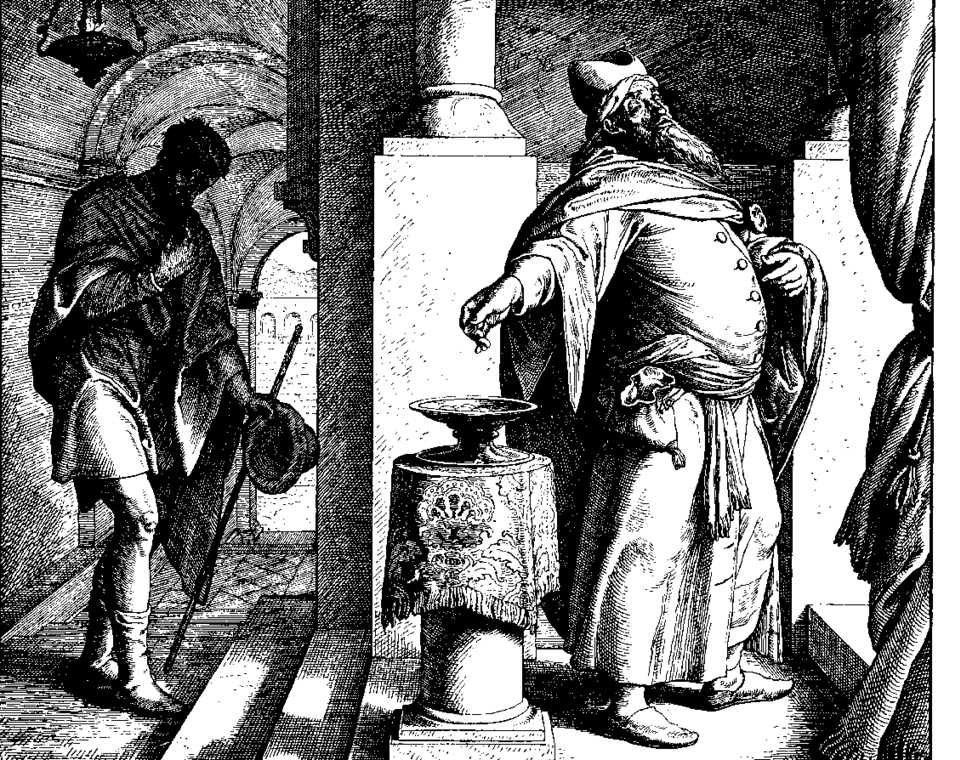
The tax collector was extremely rich. Roman tax rates were not openly published, and a tax collector was free to extort as much as he could, sending only the true amount to Rome. We can get an idea of how much wealth they could accumulate when Zaccheus tells Jesus, “If I have cheated anyone, I will restore it to him four times over” (Luke 19:1-10). The tax collector in the parable is the one who inflated your taxes four times over, and kept most of it.
So the tax collector is understandably despicable, socially despised, on the level of prostitutes and other sinners. He is an agent of Rome and a wealthy man. It was shocking that Jesus would dine with people like that; but he loved and tried to save even tax collectors.
In the parable, we’re not told the reason for the tax collector’s repentance. It must have been something powerful. He hovers in the dark at the back of the temple, bowing to the ground, asking only for mercy. He is a broken-hearted, thoroughly abject figure.

That is the rich oppressor whom Jesus calls us to admire, in this parable. It is the self-satisfied Pharisee we must condemn, who is trying to live his faith as best he can understand it, and stand between Rome and the crushed populace.
That’s a little confusing. It breaks our stereotypes. And that’s a good thing.
I have to close with an old joke. On Yom Kippur, the rabbi suddenly stops the service, prostrates himself, and proclaims, “O God, before you I am nothing!”
The lead cantor is inspired to follow suit, and throws himself to the floor beside the rabbi, crying, “O God, before you I am nothing!”
In the back, an ordinary worshiper leaps from his seat, prostrates in the aisle, and shouts, “O God, before you I am nothing!”
At this the rabbi nudges the cantor and whispers, “Look who thinks he’s nothing.”