This past Sunday was Cross Veneration Sunday for Orthodox Christians, and I gave the homily at St. Nicholas Ukrainian Orthodox Church about how the Annunciation (March 25) and the Crucifixion are the two “parentheses” around the entire Christian story. Here’s the text of my talk, and I linked below to the Youtube video.
We are deep into March now, and Annunciation is coming! We look forward to the Annunciation because it is such a bright spot in Lent. (And kids look forward to it because of the fish sticks.) This year, the Annunciation is only ten days after Cross Veneration Sunday.
I marvel over these two landmarks in the Fast. They create a parenthesis around the whole Christian story; on one side, we see the very beginning, with Gabriel announcing to Mary that she will bear a Son, and on the other, the brutality and suffering of the Cross. That’s the whole story, right there.
When the newly-pregnant Mary went to visit her cousin Elizabeth, and Elizabeth’s unborn son John leapt for joy at the approach of his Lord, Mary sang a song that has been treasured by Christians over the centuries (called “The Magnificat” in the West). Worshipers sing it in concert with Mary, and in joy. But I’ve always thought it a touching and tragic song, in light of what lay ahead.
Mary sang:
My soul magnifies the Lord, and my spirit rejoices in God my Savior … He has cast down the mighty from their thrones and exalted the humble and meek, He has filled the hungry with good things, and the rich he has sent empty away. (Luke 1:46-7, 52-3)
In 63 BC, just decades before Mary’s birth, Israel had fallen captive to the Roman Empire. Roman soldiers controlled the city, and Jewish citizens paid taxes to Rome. Jesus said, about a coin that bore Caesar’s image, “Render unto Caesar the things that are Caesar’s” (Mark 12:17).
That’s old history to us, so it’s hard to understand how bitter this was to the Jews. But we can try an analogy: imagine that America had lost World War II, and there were German soldiers patrolling our cities, and when we paid our taxes, the money went to Berlin.
If that were the case, it would surely seem to us, as it did to the Jews, that the most urgent need was to expel the invaders. Surely, that was what God wanted to happen.
But that’s not what happened.
In fact, things got much worse.
Forty years after the time of Christ, there was a desperate Jewish rebellion against the Romans. It ended in disaster.
In April of AD 70, the Romans laid siege to Jerusalem. The people were starving; some were reduced to cannibalism. The rebels had split into three separate groups, and were fighting with each other. When the Romans broke through the city wall, they killed everyone in sight. They demolished the Temple, right down to the ground.
As he came out of the temple, one of his disciples said to him, “Look, Teacher, what wonderful stones and what wonderful buildings!” And Jesus said to him, “Do you see these great buildings? There will not be left here one stone upon another, that will not be thrown down.” (Mark 13:1-2)
So the Roman emperor, “mighty on his throne,” was not cast down. Instead, he enjoyed a victory parade through the streets of Rome, with captured Jews exhibited as slaves. All the golden lamps and vessels of the Temple were carried on display. In Rome today, on the arch of Titus, there’s an image of Roman soldiers carrying off the giant golden menorah.
At the time Mary sang this song, you would have thought victory over the Romans was at hand. Even the Apostles thought so, right up to the last minute. About the most poignant line in the New Testament comes at Christ’s Ascension, when all his work on earth is done, and he is preparing to return to the Father. That’s when the Apostles gathered around to ask him, “Lord, will you at this time restore the kingdom to Israel?” (Acts 1:6)
No—that never was his plan. Restoring Israel to self-government and freedom was never his plan.
This seems strange, because we would assume that God’s top priority is saving the poor and oppressed. But a different battle was being waged, one that wasn’t about political freedom. As Jesus said to Pilate, “My kingdom is not of this world.” And so, for Mary, the Christ who lay in her arms as a baby was returned to her arms as a corpse.
Christ’s Kingdom is much bigger than anything in earthly history. It’s bigger than the universe itself. Before this universe existed, God was already locked in battle with the evil one.
And this is a battle against real evil, not Hollywood evil or pretend evil. You can get a glimpse of it sometimes when you read a horrible description of child abuse or war atrocities. When you see a kind of manic glee among the perpetrators, you get just a bare idea of what pure evil is capable of.
St. Paul said,
We are not contending against flesh and blood, but against the principalities, against the powers, against the world rulers of this present darkness, against the spiritual hosts of wickedness in the heavenly places. (Eph 6:12)
The Roman oppressors remained in power, and Mary’s song did not come true, not in the way even his Apostles expected.
But even if Israel had won a victory over Rome, would it have made a better world? Whatever effects a restored government achieved would have been just as transitory and ambivalent as any other exercise of earthly power.
So how did Mary’s prophecy come true?
We can see the first moment of real victory in the icon of the Resurrection. Under Jesus’ feet, under the broken gates of hell, you can see the evil one bound in his own chains. And Adam and Eve are being pulled up, out of their tombs, by Jesus’ might.
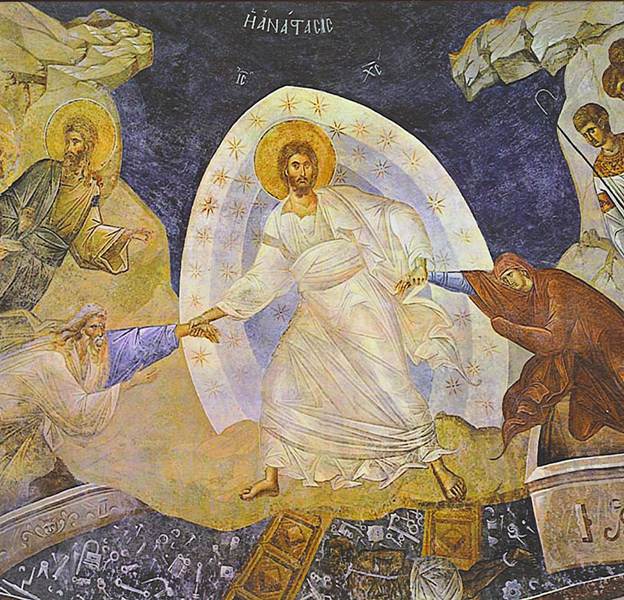
Icon of the Anastasis (Resurrection) on the ceiling in the church of Chora, outside Istanbul, 14th century. John the Baptist gestures on the left, and Abel is standing in his mother’s tomb, waiting his turn.
Now we see it: “He has cast down the mighty from their thrones, and exalted the humble and meek.”
And, mysteriously enough, this was God’s plan, even before the universe was made. A whole range of New Testament authors agree:
St. John says Christ is “The Lamb slain from the foundation of the world.” (Rev 13:8)
St. Peter says that the sacrifice of Christ “Was foreknown before the foundation of the world.” (1 Peter 1:20)
St. Matthew said Jesus revealed “What has been hidden from the foundation of the world.” (Matthew 13:34)
St. Paul says that “[God’s] works were finished from the foundation of the world.” (Heb 4:3)
and says that it is the “Plan of the mystery hidden for ages in God who created all things.” (Ephesians 3:8)
We hear that this was the plan from the foundation of the world. But why did it have to be this way? Why did God have to become human? Why did Jesus have to suffer? Why must he die and rise again?
God has not told us all the details of his plan. This was a battle fought over the children’s heads. He has told us only as much as he thinks servants need to know.
In light of that, what are we called to do?
Jesus tells us we must do some hard things, in the Gospel reading for Cross Veneration Sunday:
If anyone would come after me, let him deny himself and take up his cross and follow me. For whoever would save his life will lose it; and whoever loses his life for my sake and the gospel’s will save it. …
For whoever is ashamed of me and of my words in this adulterous and sinful generation, of him will the Son of man also be ashamed, when he comes in the glory of his Father with the holy angels. (Mark 8:34-35, 38)
These are not words of comfort; this is an uncompromising challenge. You must die to self. You must take up your Cross. Jesus’ words are harsh—but that’s because the stakes are so high.
If you’re a fan of Lord of the Rings and other hero stories, you may long to do something heroic with your own life, something that has real meaning. The consumer-world around you keeps telling you to forget about that—just enjoy yourself and buy more stuff, and eat more junk. But something inside tells you that you were made for more than that. When you think of your heroes, you wish that you, too, could take part in some epic battle between good and evil.
Listen: you are in that battle right now. You are already in that battle, and have been all your life.
Why do those hero-stories move you? Because this is what you were made for. This is what God created you to be, a steadfast warrior in the ever-present fight against evil.
“You are God’s workmanship,” says St. Paul, “created…to do good works which God has prepared for you to walk in.” (Eph 2:10) God has already prepared good works for you to do, parts for you to play, in his great battle against the evil one. This is the story you were made for.
Consumer culture tells you that the material universe is all there is, but that’s a lie. We are always moving in a matrix of spiritual powers, both good and evil. You are never alone. The whole host of heaven surrounds you. Your guardian angel is beside you every minute, ready to help, whenever you decide it’s time to get up and fight.
St. Paul says, “We are surrounded by so great a cloud of witnesses” (Hebrews 12:1). We are surrounded by those invisible witnesses who endured suffering and stood for Christ. They stand around us now and see us called, like every generation before us, to step forward bravely on the battlefield.
And the closest battlefield, the one to start on, is your heart. But that’s a topic for another day.