For Father’s day, cartoonist Ellis Rosen offered a series of pictures featuring his dad.

True confessions: Sometimes I buy the celebrity magazines in the grocery store check-out line. I have no idea who those people are, but I like looking at them. Their lives are hard—chained to a life lived in public, which demands particular facial expressions, particular reactions, or face horror and condemnation. These people are not necessarily smarter than the average guy, and they have to jump forward with the right words at the right time, or possibly destroy their career. And they hear the clock ticking. They are trying to spend their few years in the sun (the broiling sun), knowing a new crop of beautiful young people will roll out every year. These people often look like they need prayer.
I confess that this hobby started out, years ago, as pure schadenfreude. It was a magazine with a cover story on “Plastic Surgery Failures,” and I thought that sounded like fun. And it was, till I realized that this was a real person whose face, and possibly her career, had been ruined. So sometimes I buy those magazines. I am not above having schadenfreude impulses even now, but I hope the percentage of people-seen-as-real-people is growing.
A friend challenged Sdn David Mathewes to write a song for this title: “Saved at the Walmart.”
“Set aside my bad behavior, Took Sam Walton as my savior”

How it works: The reason beekeepers use smoke when they want to harvest honey is that it makes the bees think their hive is on fire. They quickly eat some of the honey (depositing it in their honey-storage stomach, not their digestive stomach), and fly off seeking a new place to live. When their stomachs are full, they can’t bend their bodies into a curve, which is necessary for them to be able to sting. That’s kind of cute. So they fly away out of the hive, and the beekeeper can harvest honey in peace.
My husband randomly googled my name the other day, and was surprised when it AI-informed him that I am the mother of Elizabeth S. Elizabeth is a member of our congregation, a lovely young lady, and I’m fond of her. But I’m pretty sure (check notes) I did not give birth to her.
My hubby and I joked around about it. I wondered if I am also the mother of her sister in Murfreesboro. I wondered who the father is. My husband pointed out that this will be a big surprise to our sole certified daughter, Megan.
But thinking about it afterward, I could see how this sort of thing could undermine our ability to trust any internet information. What if people took the addition to our family as accurate, and inserted it into other online sources, and the idea just kept on reproducing (so to speak)? What evidence could you ever bring to show it was not true? Pit website A against website B, saying different things, but there’s no way to determine which is actually accurate, except by citing other websites.
Father Gregory and I do have a daughter, but only one; her name is Megan Mathiesen, and she is a hospice chaplain in Lancaster PA.

Megan asked AI to make the photo into a “cute cartoon:”

AI thinks it needed some cleavage. The hearts are real, though.
She recently inherited a one-eyed cat from one of her hospice patients:
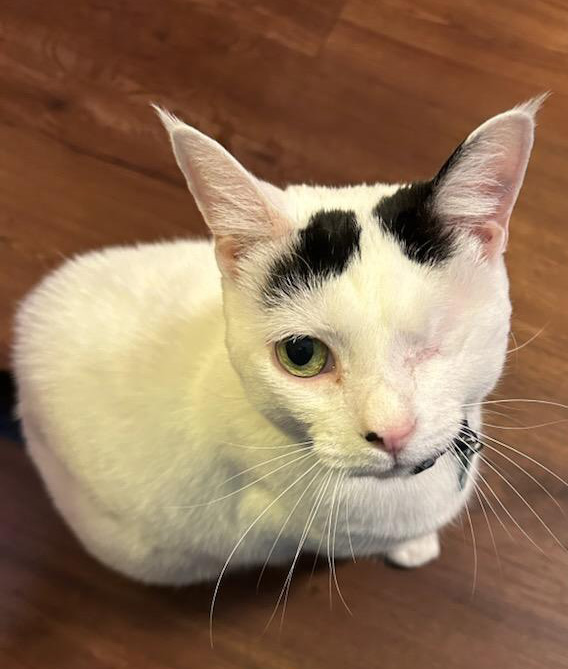
(Coloring I’d never seen before: white with a black tail. Ear tufts like a Maine Coon cat. He’s a big cat, too. Extremely contented and affectionate.)
The AI cartoon of Buddy has two eyes. And it straightened out his wandering eyebrows.

“What is reality?” we old hippies used to cry.
I am a very ambivalent AI user, and think that I should be using Duck Duck Go No AI. But there are times when I can’t get at the info I need that way, and it’s so helpful to be able to phrase a question the way you’d ask a person. Then AI is able to sort out what I’m after, when a regular search engine could not. This is terrible, but I haven’t been able to keep my No-AI promise so far. I don’t ever use AI to create anything—I don’t give it access to my mind—but it’s become so seductive if you’re doing research.

Well, it’s frustrating. But I’m old enough to remember the old way of searching for current information: go to the library and consult the big book that comes out every year, that lists topics alphabetically, followed by the name and date of articles dealing with that topic, in the past year’s magazines and newspapers. It’s possible that copies of the magazine or newspaper were stored somewhere in the library building; if not, maybe you could find them at another library. But once you got your hands on the article, there was no guarantee that it would cover the information you were looking for. So AI is mighty seductive for writers who want to know, real quick, which Church Father said what.